Society Registration In Kanpur
Get Legal Recognition for Your Non-Profit Organization
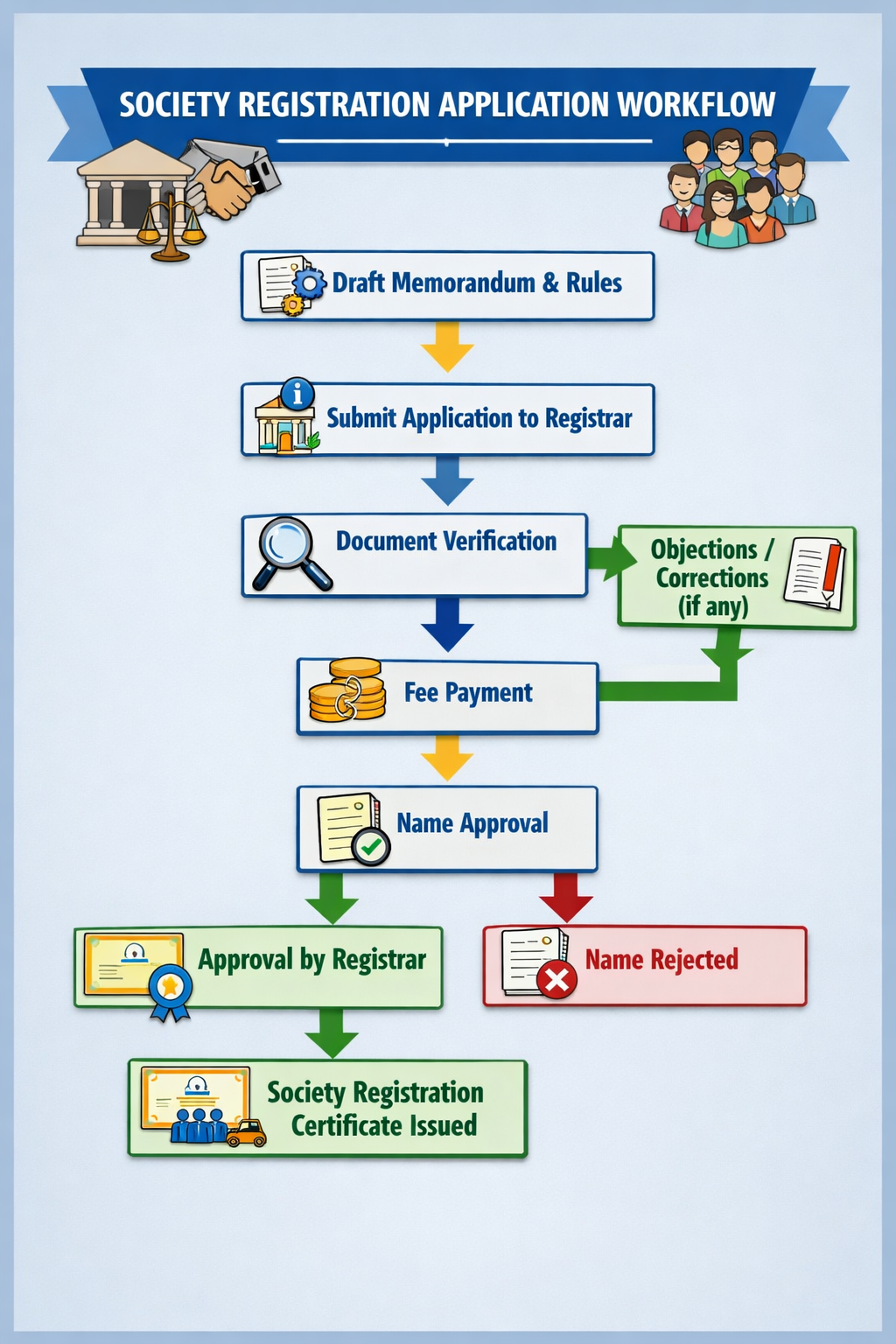
A Society is an association of individuals formed for charitable, cultural, or religious purposes. Registered under the Societies Registration Act, 1860, it provides legal identity, tax benefits, and operational flexibility for running non-profit activities.
Benefits of Society Registration
Legal Status & Recognition – Enhances credibility for fundraising & donations.
Tax Exemptions – Eligible for 12A & 80G benefits. Limited Liability – Protection for society members. Easy Fundraising – Access to grants & government support
Documents Required for Registration
- Society Name & Objectives
- PAN & Aadhaar of Founding Members
- Registered Address Proof
- Memorandum of Association (MoA) & By-Laws


Our Registration Process
- Consultation & Eligibility Check
- Document Preparation & Filing
- Approval & Society Registration Certificate
- Compliance & Tax Exemption Assistance
Frequently Asked Questions
1. Legal Structures & Eligibility
What are the different ways to register an NGO in India? You can register as a Public Charitable Trust, a Society, or a Section 8 Company.
Which structure should I choose?
Trust: Best for small, asset-focused initiatives with long-term control.
Society: Ideal for community-driven work with flexible, membership-based governance.
Section 8 Company: Best for large-scale operations requiring high credibility and corporate funding opportunities.
How many members are required?
Trust: Minimum 2 trustees.
Society: Minimum 7 members.
Section 8 Company: Minimum 2 directors.
2. Documents & Process
What mandatory documents do I need for registration? While it varies by structure, common requirements include:
ID & Address Proof: PAN and Aadhaar for all core members/directors.
Office Address Proof: Recent utility bill or rent agreement plus a No Objection Certificate (NOC).
Constitutional Documents: Trust Deed (Trusts), MoA and Rules (Societies), or AoA and MoA (Section 8 Companies).
How long does the registration process take?
Trusts/Societies: Usually a few weeks.
Section 8 Companies: Can take a few months due to additional central government approvals.
3. Tax & Government Compliances
What is a “Registered Non-Profit Organisation” (RNPO)? In 2026, RNPO is the unified term under Section 355(g) of the Income Tax Act for any entity with a valid registration (formerly Trust, Society, etc.).
Are 12A and 80G registrations still necessary? Yes. 12A registration makes the NGO’s income tax-exempt, while 80G registration allows donors to claim a 50% tax deduction on their donations.
What is the current validity for tax registrations? Standard registrations last 5 years. However, smaller trusts with an income not exceeding ₹5 crore for two consecutive years may receive a 10-year validity.
What is NGO Darpan registration? It is a mandatory portal for NGOs to receive government grants and CSR funds.
4. Post-Registration Duties
Can an NGO earn a profit? Yes, but the profit cannot be distributed among members; it must be reinvested entirely into the NGO’s charitable objectives.